


Everyday movements like getting out of bed, moving to a chair, or getting to the bathroom can become much harder when someone’s mobility changes. What used to be a simple transfer may suddenly require more strength, balance, and help from a caregiver.
That’s where a patient lift can make a real difference. The right lift can provide support during transfers and reduce how much physical lifting a caregiver has to do by hand. But there isn’t one patient lift that works for everyone.
Choosing the right one depends on several things, including how much weight the person can safely bear through their legs, how much they can participate in the transfer, the amount of caregiver assistance available, and the space where the lift will actually be used.
At Med Mart, we carry different types of patient lifts because those needs can vary quite a bit from one person to another. In this article, we’ll break down the main types, explain where each one may fit, and look at a few patient lifts worth considering.
The Everyday Challenges of Transferring With Limited Mobility
Transfers can become difficult for a number of reasons. Reduced strength, balance problems, joint discomfort, or changes in mobility can all make movements like getting out of bed or standing from a chair more challenging.
Sometimes the change happens gradually. A family member may start needing a little help getting up, then more assistance a few months later. Caregivers may also find themselves doing more physical lifting than they expected.
Some common signs that it may be time to look at additional transfer support include:
- Legs feeling weak when standing
- Fear or hesitation during bed-to-chair transfers
- Caregivers feeling strain in their back, shoulders, or knees
- Difficulty pushing up through the legs
- Trouble safely assisting with a person’s full body weight
The goal isn’t to wait until every transfer feels like a struggle. Understanding the options earlier can make it easier to choose equipment that matches the person’s actual needs.
If you’re just starting to research patient lifts, our guide on buying a patient lift is another good place to begin.
What Patient Lifts Are and the Main Types You Can Choose From
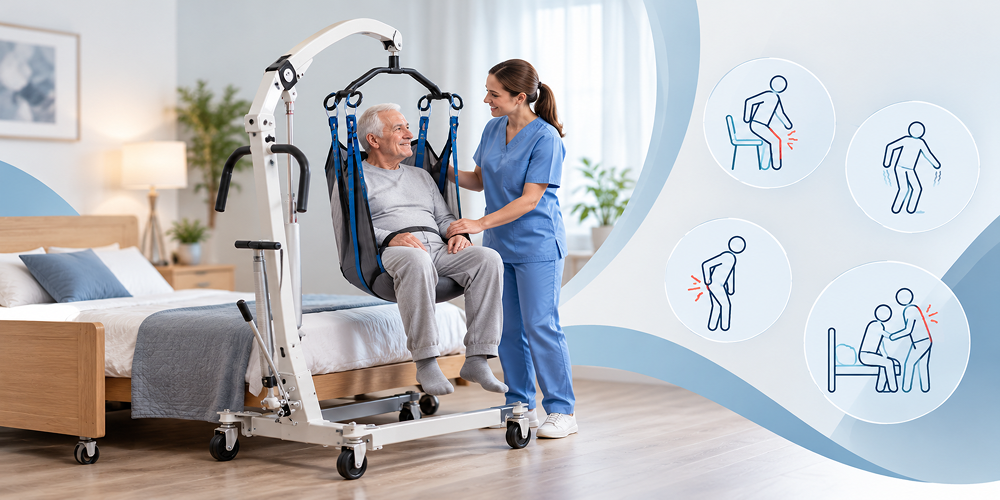
A patient lift is a mobility device designed to help move a person from one position or location to another, such as from a bed to a chair. Depending on the lift, the person may be supported by a sling, standing aid, or other positioning system rather than being physically lifted by a caregiver. There are several different types of patient lifts, and they aren’t interchangeable.
According to recent data from Fortune Business Insights, the patient lift market is predicted to grow steadily from $2.22 billion in 2026 to $3.13 billion by 2034. As demand grows, different patient lift types serve different needs.
Patient lift types include:
- Electric patient lifts that use powered controls to raise and lower the person
- Manual patient lifts that use a hand-operated hydraulic pump
- Sit-to-stand patient lifts for people who can participate in standing and meet the lift’s weight-bearing requirements
- Heavy-duty patient lifts built with higher weight capacities
- Folding patient lifts designed to make storage or transportation easier
- Specialized patient lifts for specific transfer needs
- Bath lifts to assist with getting in and out of a bathtub
- Pool lifts to assist with entering and exiting a swimming pool
One of the basic differences between an electric patient lift and a manual lift is how the lifting mechanism is powered. Electric models use battery-powered controls, while manual lifts generally use a hand pump. Neither one is automatically better. It really depends on how often the lift will be used, the caregiver’s abilities, and what works best in the home.
Patient Lift Benefits That Make Everyday Movement Easier at Home
A properly selected patient lift can make transfers more manageable for both the person being moved and the caregiver helping them.
The important part is choosing the right type of lift and using it according to the manufacturer’s instructions. A full-body lift and a sit-to-stand lift, for example, are designed for very different levels of mobility.
Safer Transfers With Fewer Falls
Transfers are often the point where balance becomes a concern. Standing up, turning, and lowering into another seat all require coordination and control.
A full-body lift can support the person during the transfer when they’re unable to safely bear enough weight through their legs. A sit-to-stand lift is designed for people who can participate in the standing movement and meet the manufacturer’s requirements for that type of lift.
Features to look for may include:
- Secure sling attachment points
- Caster brakes or positioning features
- Smooth lifting and lowering controls
- Emergency stop or emergency lowering functions
Those features can provide more support and control during a transfer, but proper setup, the correct sling, and caregiver training still matter. A lift is a tool, and it needs to be used correctly.
Support That Matches Your Weight-Bearing Ability
This is one of the biggest factors when choosing a patient lift.
Some people can bear a fair amount of weight through their legs but need help getting fully upright. Others may only be able to bear a little weight, or none at all.
That difference can completely change which lift makes sense.
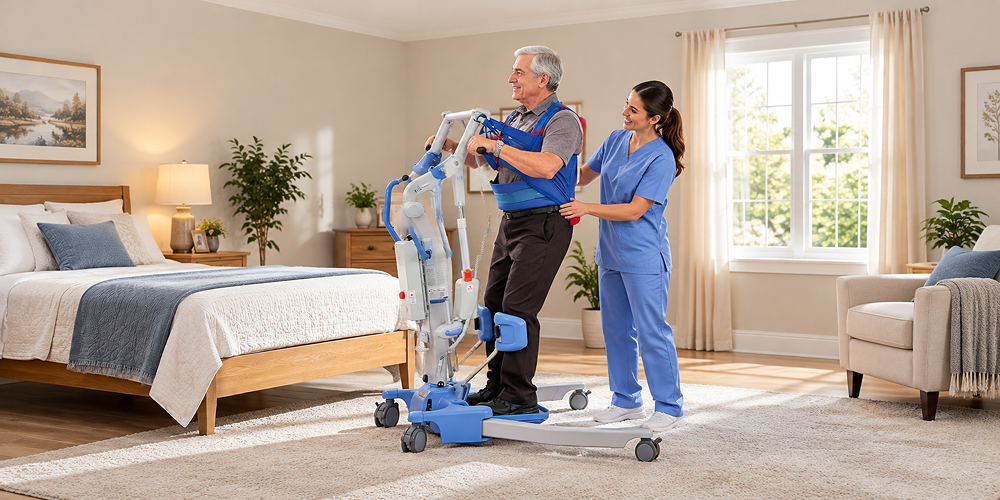
A full-body lift may be appropriate for someone who can’t safely support themselves during the transfer. A sit-to-stand lift, on the other hand, is intended for someone who can participate in the movement and has enough strength and control to meet the lift’s requirements.
Things to consider include:
- Whether the person can safely bear weight
- How much assistance they need to stand
- Whether they can follow directions during the transfer
- The type and size of sling or support needed
- The lift’s weight capacity
The idea isn’t to choose the lift that does the most. It’s to choose the lift that provides the right amount of support for that individual.
Less Strain on Family Caregivers
Helping someone transfer by hand can be physically demanding, especially when it happens several times throughout the day.
Repeated lifting and repositioning can put a lot of stress on a caregiver’s back, shoulders, knees, and arms. A patient lift can reduce how much of the person’s body weight the caregiver has to physically support during a transfer.
Features that may make a lift easier for caregivers to use include:
- Push-button or easy-to-operate controls
- Comfortable handles for maneuvering
- Casters designed to move across appropriate flooring
- Folding frames for storage when space is limited
The goal is to make the transfer more manageable for everyone involved, not simply shift the difficulty from the person being transferred to the caregiver.
More Comfort and Dignity During Every Move
Transfers are personal. Being physically lifted or repositioned by another person can feel uncomfortable or awkward, especially when mobility has recently changed.
A properly sized sling and a lift that matches the person’s needs can provide more consistent support during the movement.
Comfort details worth checking include:
- The correct sling size and style
- Padding where appropriate
- Base width and leg clearance
- Smooth lifting and lowering motion
It’s worth taking the time to get those details right. If the sling doesn’t fit properly or the lift feels awkward in the room, people are a lot less likely to feel comfortable using it every day.
More Independence at Home
A patient lift doesn’t necessarily mean taking independence away. In some situations, the right lift can actually help someone continue participating in daily routines at home.
For a person who can still bear some weight, a sit-to-stand lift may allow them to participate in the transfer rather than relying completely on a caregiver. For someone with less mobility, a full-body lift may make it possible to move between the bed, chair, or other areas of the home with more support.
Helpful features may include:
- Sit-to-stand designs for appropriate users
- Compact frames for smaller spaces
- Folding options for storage
- Casters that allow the lift to move between rooms
Again, it comes back to choosing the lift around the person rather than trying to make the person fit the equipment.
Top Five Patient Lifts From Med Mart for Safer Daily Transfers
These five Med Mart patient lifts cover several different transfer needs, including folding, sit-to-stand, powered, floor-lift, and higher-capacity options. None of them is the “best” lift for everyone. The right choice depends on the person using it and how transfers are handled at home.
Hoyer® Advance-E 340 Folding Patient Lift
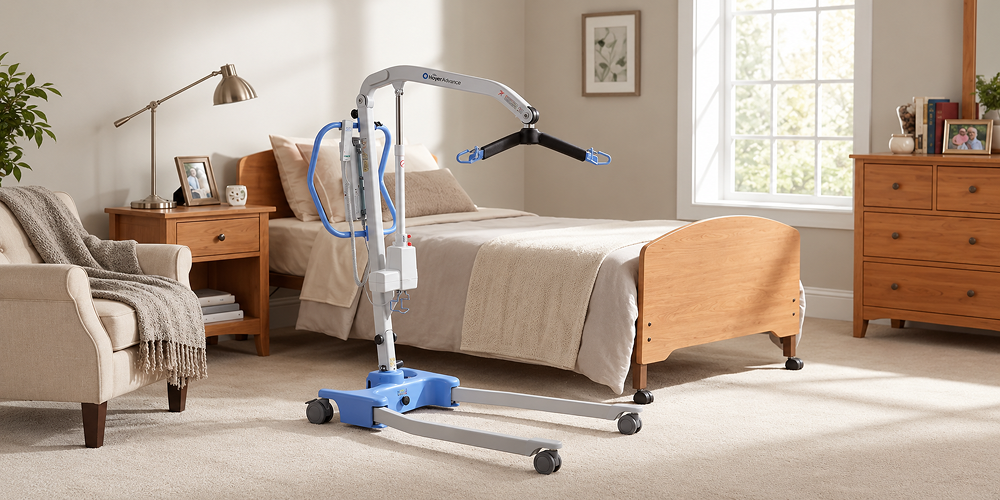
The Hoyer Advance-E 340 Folding Patient Lift is built with a lightweight aluminum frame and folds without tools, which can be useful when storage or transportation is part of the decision.
Its swan-neck leg design also helps the lift move closer to the person during certain transfers.
Hoyer® Advance-E 340 Folding Patient Lift
Product highlights
- Tool-free folding
- Lightweight aluminum construction
- Oversized steering handle
- Stands upright when stored
- Foot-operated base adjustment
- Push pad to help start movement
- Swan-neck leg design
This lift may be worth considering for someone who needs a full patient lift but also wants something that can be folded and stored easily.
Hoyer® Journey Smart Monitor Sit-to-Stand Lift
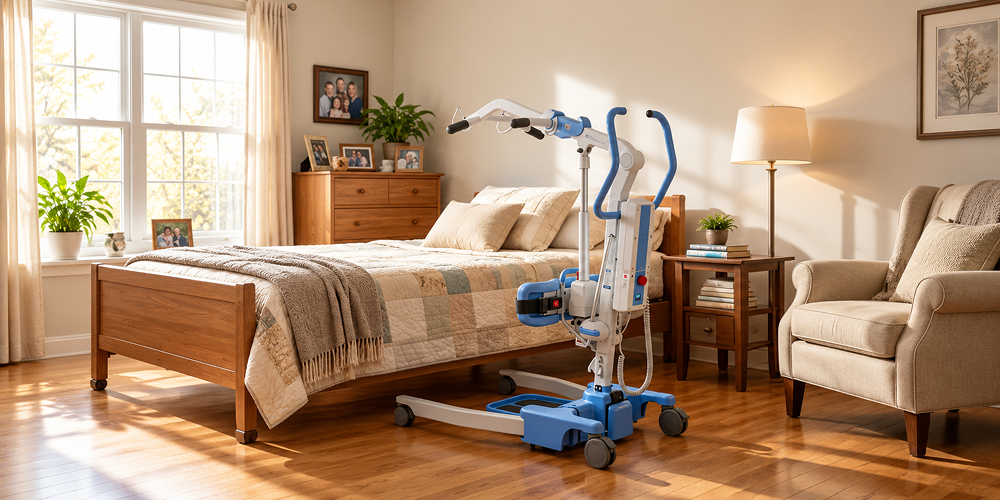
The Hoyer Journey Smart Monitor Sit-to-Stand Lift is designed for users who can participate in the standing process and meet the lift’s mobility requirements.
It has a folding frame, adjustable knee support, and an adjustable cow-horn support system to accommodate different users.
Hoyer® Journey Smart Monitor Sit-to-Stand Lift
Product highlights
- Folding design
- Stands upright when folded
- Adjustable cow-horn support
- Adjustable kneepad
- Protective bump guard
- Two batteries with offboard charger
- Foot pedal for base adjustment
This type of lift may make sense for someone who still has some weight-bearing ability and can participate in the transfer rather than relying on a full-body sling.
Maxi Move® 5 Multifunctional Patient Floor Lift
The Maxi Move 5 Multifunctional Patient Lift is an electrically powered floor lift with a weight capacity of up to 450 pounds. It offers powered height and base adjustments and can be operated by pendant or control box. An optional built-in scale is also available.
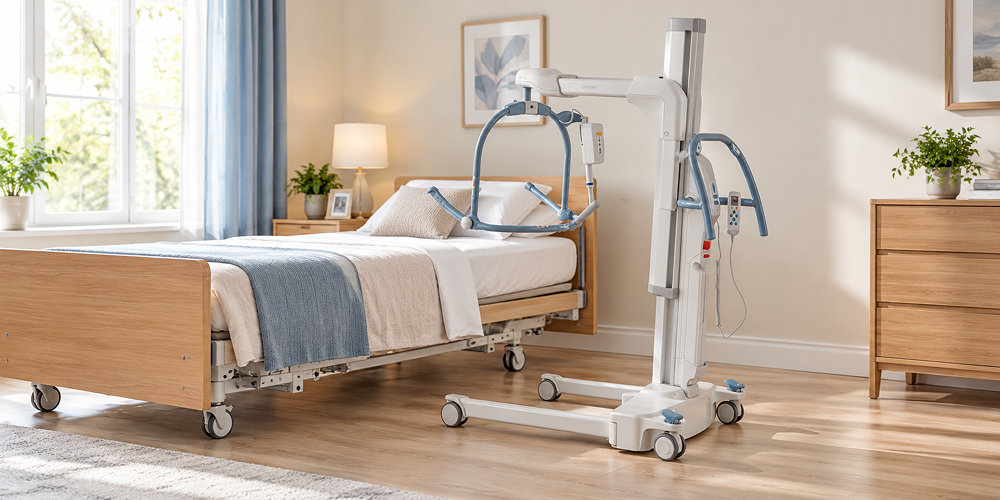
Maxi Move® 5 Multifunctional Patient Floor Lift
Product highlights
- Electric height adjustment
- Electric base adjustment
- 450-pound weight capacity
- Pendant or control-box operation
- Optional built-in scale
- Ergonomic push handles
- Kick bar for repositioning
- Tool-free folding for storage
This may be a good option when powered adjustments and a higher level of caregiver assistance are needed.
Molift® Partner 255 Vertical Patient Lift
The Molift Partner 255 Vertical Patient Lift has a safe working load of 560 pounds and uses a four-point sling bar. Its vertical lifting design is intended to provide room between the person and the lift during transfers.
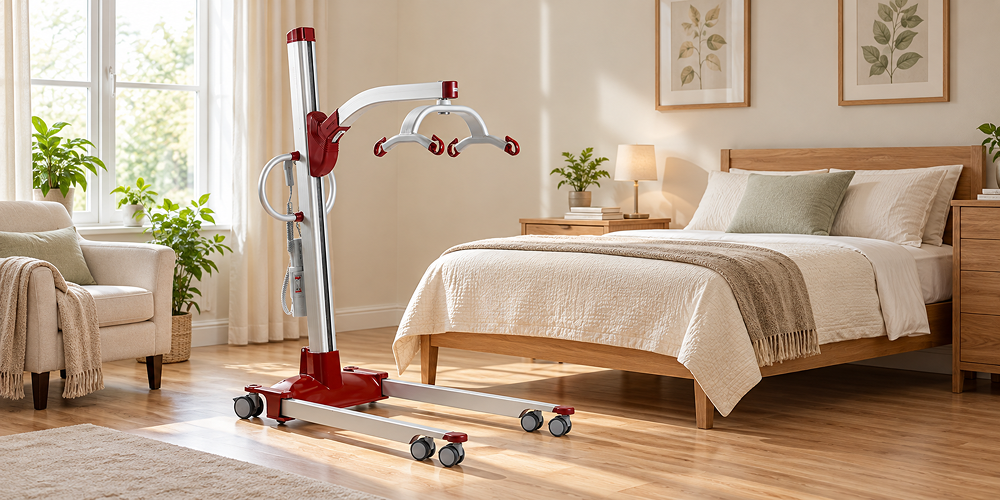
Molift® Partner 255 Vertical Patient Lift
Product highlights
- 560-pound safe working load
- NiMH battery
- Vertical lifting design
- Four-point sling bar
This model may be worth looking at when higher weight capacity and a full-body lifting system are important parts of the decision.
Hoyer® Deluxe Power Patient Lift
The Hoyer Deluxe Power Patient Lift has a 400-pound weight capacity and can be used with several sling configurations. Its adjustable U-base can help with positioning around furniture, and the lift also includes protective features such as leg guards and caster bumpers.
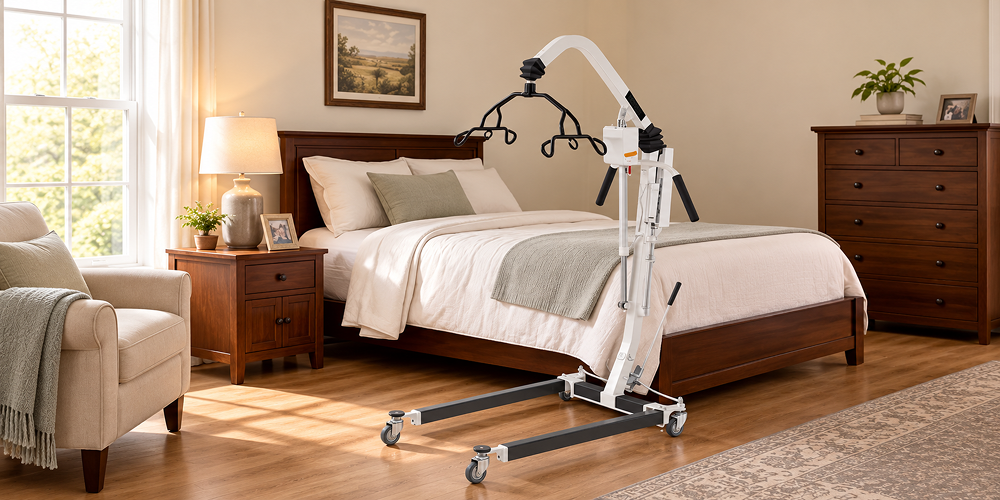
Hoyer® Deluxe Power Patient Lift
Product highlights
- Compatible with multiple sling styles
- 400-pound weight capacity
- Dual casters
- Adjustable U-base
- Ergonomic handles
- Leg guards and caster bumpers
- Reverse actuator for additional legroom
- Emergency stop button
This is another full-body power lift option for someone who needs more support during transfers and wants a powered lifting system.
Choosing a Lift That Fits Your Life
There really isn’t a shortcut to choosing the right patient lift.
Start with the person using it. How much weight can they safely bear? Can they participate in standing? Will they need full-body support? Then think about the caregiver. Who’ll be operating the lift, how often will it be used, and how comfortable are they maneuvering it?
The home matters too. Measure doorways, look at the flooring, think about the space around the bed or chair, and figure out where the lift will be stored when it’s not being used. Those details can make the difference between a lift that looks good online and one that actually works well in everyday life.
At Med Mart, we carry patient lifts for a wide range of mobility and weight-bearing needs. Our product specialists can help compare options and explain the differences so you can narrow down which type of lift makes the most sense for your situation. We also offer free lifetime technical support and a price-match guarantee.
Contact us if you’d like help finding the right patient lift for you or someone you care for.
Frequently Asked Questions
1. Can a patient lift fit through a bedroom doorway?
Many floor lifts have bases that open and close, which can make it easier to move through doorways.
Before choosing a lift, check the base width in its closed position and compare that with the actual doorway opening. Don’t forget to look at the space on both sides of the doorway too. Getting through the door is only useful if there’s enough room to maneuver once you’re inside.
2. Will using a patient lift make my legs weaker?
Using a patient lift doesn’t automatically cause leg weakness.
The effect on someone’s mobility depends on their health, activity level, weight-bearing ability, and rehabilitation plan. In some situations, a sit-to-stand lift may allow an appropriate user to continue participating in the standing movement.
If maintaining strength or mobility is part of the goal, a physical or occupational therapist can help determine which type of lift and transfer method is appropriate.
3. How long does it take to learn to use a patient lift?
That varies depending on the lift and the caregiver.
No one should feel rushed to use a patient lift independently before they understand how it works. Caregivers should be shown how to position the lift, use the correct sling or support system, operate the controls, and complete the transfer according to the manufacturer’s instructions.
A little practice ahead of time can go a long way toward making the process feel more comfortable.
4. Where should I keep a folding patient lift?
That depends on the model and the space available in the home.
Some folding lifts are designed to stand upright when folded, which can make them easier to keep in a closet, bedroom corner, or another out-of-the-way area.
Always check the manufacturer’s storage instructions before deciding where to keep the lift.
5. Can a patient lift roll over carpet?
That depends on the lift, the casters, and the type of carpet. Smooth, hard flooring is generally easier to maneuver across than thick or plush carpeting. If the lift will regularly be used over carpet, it’s worth checking the manufacturer’s recommendations and considering how easily the caregiver can actually move it in that room. Testing the planned route before relying on the lift for everyday transfers is a good idea.